
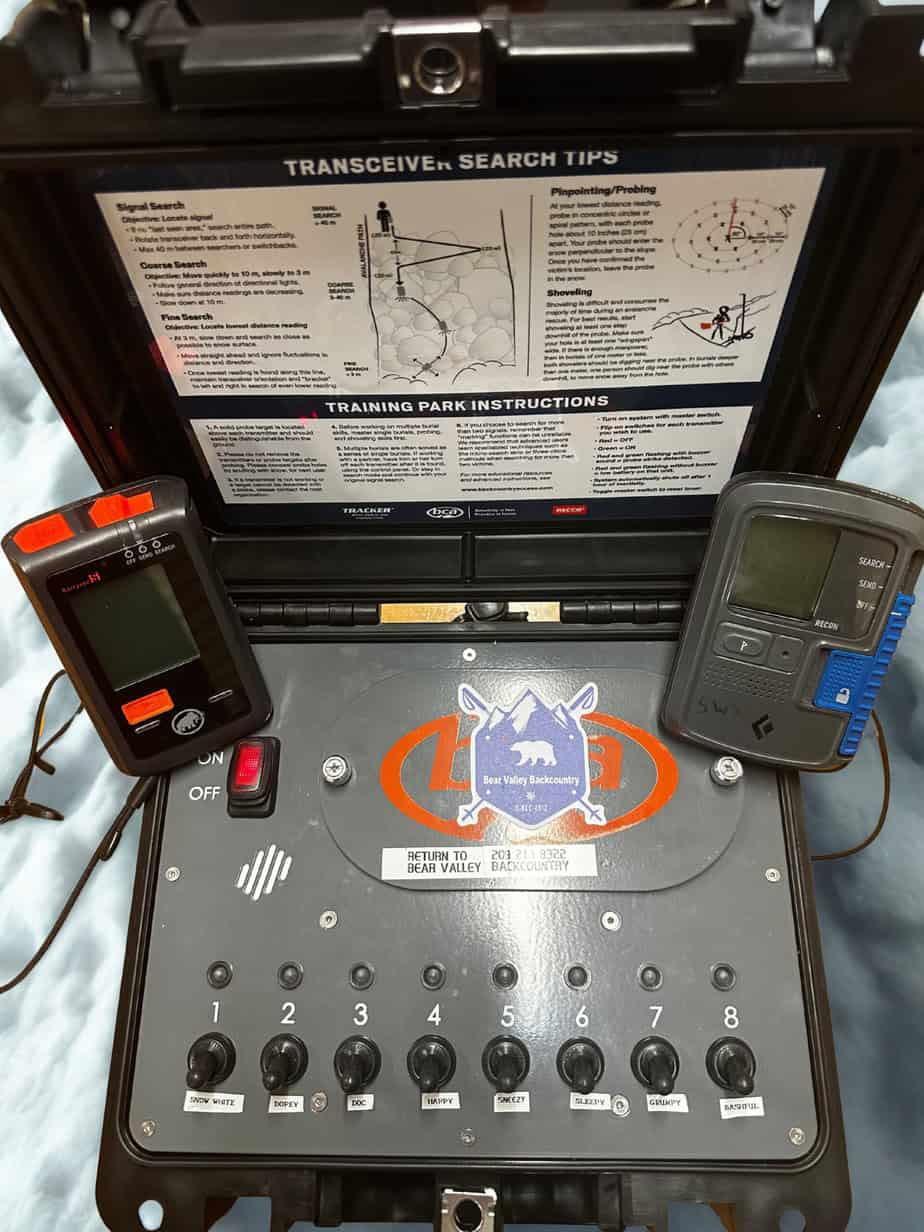
What is a beacon park? It is a designated training area containing up to eight buried beacon-transmitting units. These parks feature a control box that allows you to turn on or off all (or some) of the transmitters to simulate different search scenarios.
Avalanche Beacon Parks serve as convenient and essential training grounds for skiers, snowboarders, snowshoers, or anyone entering avalanche terrain. They provide a controlled environment to practice using avalanche beacons effectively, ensuring adventurers are prepared for emergencies in real-world situations.
Avalanche safety is crucial for anyone venturing into backcountry or side-country areas at ski resorts. In this post, we’ll explore where to find Avalanche Beacon Parks and provide tips on how to use them.
Where to Find Avalanche Beacon Parks in California
Avalanche beacon training parks in California are designed for practicing backcountry rescue skills and are primarily located at major ski resorts in the Sierra Nevada and Mammoth regions.
The most notable free, public-access park is Mammoth Mountain’s Gus’s Pasture. Other locations that often feature beacon training areas include:
- Bear Valley, California Community Beacon Park – NOW OPEN– hosted by BV Backcountry / California Ski Guides located in the Bear Valley Lodge. (Call 209-213-8322 for information).
- Mammoth Mountain: Located in Gus’s Pasture, open daily.
- Kirkwood Mountain Resort
- Heavenly Mountain Resort
- Palisades Tahoe / Alpine Meadows
- NorthStar California
- Homewood Mountain Resort
- Sierra-at-Tahoe
- Mt. Rose Ski Tahoe
These parks allow users to practice using their own transceivers to locate buried, fixed transmitters. Note: It is highly recommended that you check with individual ski patrols or guest services for exact, current locations, as they may change based on snow conditions.
Where to Find Beacon Parks in Other Areas
- Ski Resorts: Many ski resorts in mountainous regions have dedicated Avalanche Beacon Parks. As part of their commitment to safety, resorts often include these parks for visitors, offering free or low-cost access. Check with local resorts like Whistler Blackcomb, Jackson Hole, and Aspen to see if they have Beacon Parks onsite.
- Local Climbing or Skiing Guides: Local outdoor adventure guides and climbing organizations may have specific Beacon Parks or recommend sites for practicing beacon skills. It is worth reaching out to them for insights, especially if you are in a new area.
- Public Parks and Avalanche Safety Programs: Some public parks or municipalities collaborate with avalanche safety experts to establish training parks. Look for announcements from local safety programs or community centers.
How to Use an Avalanche Beacon Park
- Familiarize Yourself with Your Beacon: Before heading to the park, read the manual for your avalanche beacon thoroughly. Different models have varying features, so understanding your specific device is crucial for effective training.
- Practice in a Controlled Environment: When you arrive at the Beacon Park, take your time setting up your beacon in search mode. Many parks have buried beacons that emit signals at various depths to simulate realistic avalanche scenarios.
- Master Search Techniques:
- Primary or Coarse Search: Begin with your beacon in “receive or search” mode to find a signal. All other beacons need to be either off or on “receive or search mode”.
- Secondary Search: Once a signal is acquired, follow the direction and distance arrows on your beacon until you are within 3-5 meters.
- Pinpoint or Fine Search (within 3-5 m): Once you are near (within 3-5 meters), start your fine search technique and slow down. You will sweep back and forth close to the snow surface to “box” or bracket the lowest number on the beacon, keeping the beacon oriented in one direction. This helps you pinpoint the signal location. Then, probe in a spiral pattern to find the beacon or the park’s sensor plate. (Note: Many established parks use pressure-sensitive plates that emit a beep at a control box when struck.
- Important: This description does not replace proper training from a certified Avalanche Instructor.
- Practice Multiple Burials: Many parks allow you to practice searching for multiple beacons simultaneously. This is an excellent opportunity to test your skills under more complex, high-pressure scenarios.
- Team Practice: Bring your friends or family along. Practicing as a team simulates real-life dynamics in an avalanche situation, allowing you to learn how to communicate and strategize effectively while searching for an injured party.
- Attend Workshops: If you are new to avalanche safety, consider enrolling in clinics, events, or avalanche courses offered at park locations, such as the Bear Valley Beacon Park. These sessions are typically hosted by experienced instructors and will significantly elevate your skills and knowledge.
- Feedback and Improvement: After each practice session, take time to discuss your experiences with your group. Evaluate which techniques were effective and identify what was most difficult.
Conclusion
Avalanche Beacon Parks are invaluable resources for anyone serious about backcountry safety. By practicing your skills regularly, you build confidence and competence in avalanche rescue, significantly increasing safety for you and your group.
Always remember that while Avalanche Beacon Parks are excellent training grounds, nothing replaces real-world experience and formal education in avalanche safety. Before heading into the backcountry, GET THE AVALANCHE FORECAST*, GET THE GEAR* (beacon, probe, and shovel), and GET THE TRAINING*, and GET OUT OF HARMS WAY.* *Look for KBYG — “Know Before You Go” Avalanche awareness programs in your area.
by: Timothy S Keating
Founder SWS Mountain Guides
Avalanche Educator